Cybersecurity
CastleOSINT Build Update — From Workflow Concept to Investigation Platform
How CastleOSINT grew from an organized research workflow into a local investigation platform connecting cases, evidence, entities, notes, search, and reporting.
CastleOSINT started with a practical problem: keeping an investigation organized while moving between research tools, browser tabs, captured evidence, and notes.
The early work focused on a repeatable workflow around my Kali workstation, CastleWatch. Case directories, intake documentation, lead tracking, evidence IDs, and Obsidian templates gave that research a consistent structure. I wanted to be able to return to a case and understand both what I had found and how I had reached it.
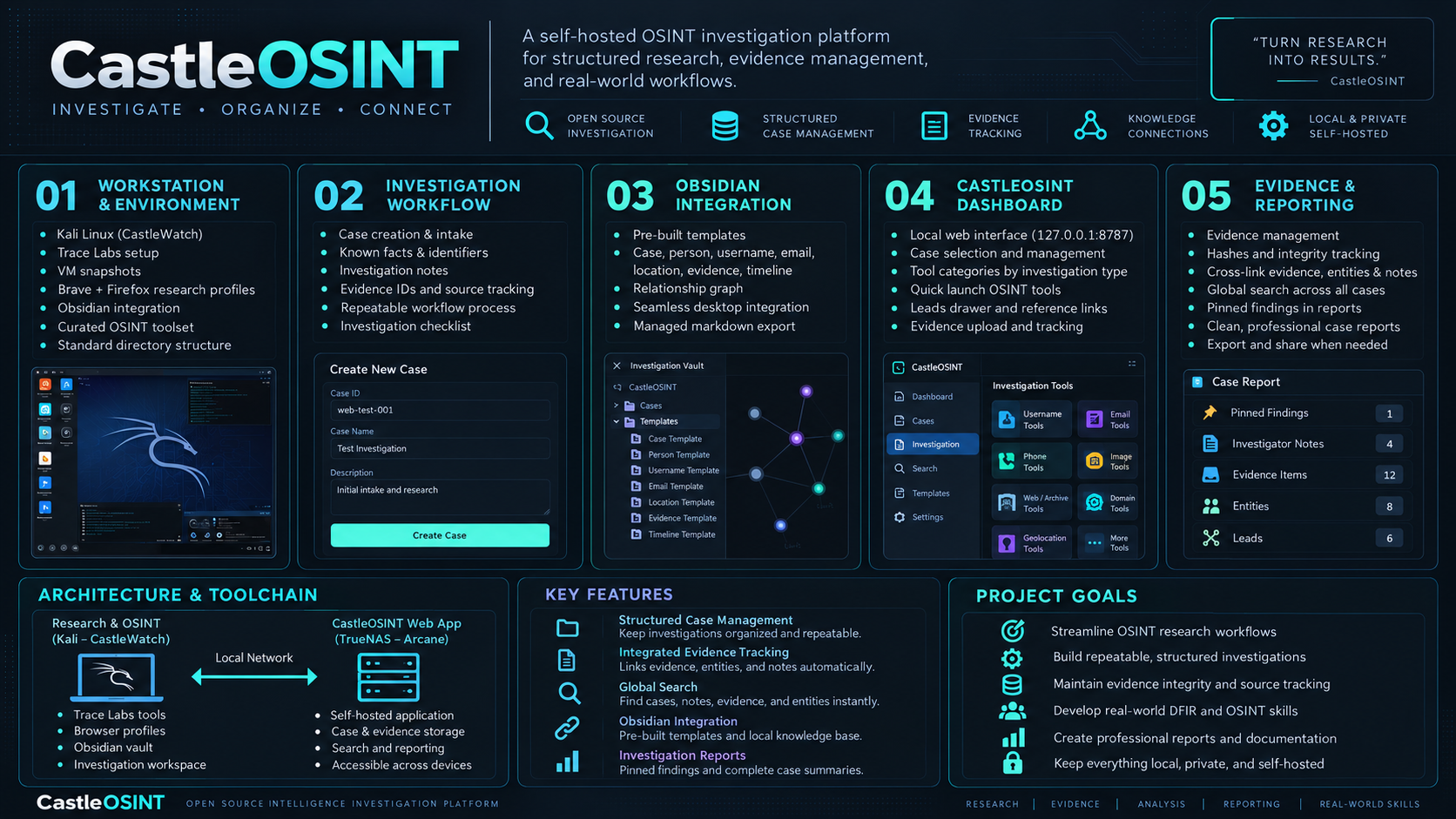
That foundation has now grown into a functional, self-hosted investigation platform. A local web interface brings the pieces together, from opening a case to preparing a report. The biggest milestone is that the research, supporting material, and investigator analysis now connect within the same workflow.
A case becomes the center of the work
Structured case management gives each investigation a home. Leads, evidence, entities, and notes can be organized around the case instead of spread across unrelated files and tabs.
Lead tracking provides a place to record possible directions for research and the next questions to work through. Entity records help organize the people, accounts, organizations, and other subjects that appear along the way. Together, they make it easier to follow a lead while keeping its relationship to the wider investigation visible.
The underlying case structure still matters. The web interface builds on that organization and makes it more practical to use during an investigation.
Evidence with context and integrity checks
CastleOSINT now supports evidence capture and import, bringing collected material into the case workflow. Evidence records provide a place for the details that make an item useful later: its source, its relevance, and the context behind collecting it.
Editable evidence metadata means those descriptions can be refined as the investigation develops. An initial capture may need a clearer explanation after another lead or entity provides more context.
Integrity hashing adds a separate check on the collected files. Comparing a file against its recorded hash helps identify whether its contents have changed. That answers a different question from whether a source is accurate; assessing the source and interpreting the material remain part of the investigator’s work.
For me, the value is being able to preserve the material and explain why it belongs in the case.
Investigator notes connect the reasoning
Evidence alone does not explain an investigation. Notes record the observations, questions, and findings that turn collected material into analysis.
Investigator notes now support cross-links to evidence and entities. Smart pickers make those references easier to add without manually looking up and copying every identifier. A finding can point back to the material behind it and the subjects it concerns.
For example, a note about a possible connection between two accounts can reference the relevant entity records and captured evidence. When I revisit that note, I can follow its supporting material instead of reconstructing the research from memory.
This is an important step toward keeping observations and conclusions understandable as a case grows.
Search and Obsidian keep the work accessible
Global search brings another way into the investigation. Cases, leads, evidence, entities, and investigator notes can be found through a shared search workflow, reducing the need to remember exactly where an item was recorded.
Obsidian remains part of the wider setup. The integration connects the structured case workflow with a Markdown-based analysis workspace, including a managed Markdown representation of investigator notes. That keeps longer-form thinking close to the case material while the browser interface handles day-to-day organization.
The aim is continuity: information recorded during research should remain useful when it is time to review, connect, and explain the findings.
Reports carry the findings forward
Reporting now includes investigator notes and their evidence and entity references. Pinned findings appear near the top of the report, bringing the most important conclusions into view while retaining the supporting detail later in the document.
That changes the report from a collection of case records into a more useful investigator deliverable. The reader can start with the findings and then work through the notes and references that support them.
It also closes an important loop in the workflow: case work → notes → search → report. Analysis recorded during the investigation can carry forward into the final write-up.
Built around a local, self-hosted workflow
CastleOSINT uses a local web interface backed by Python and FastAPI, with JavaScript supporting the browser experience. Kali Linux and Obsidian remain part of the surrounding research environment.
The local, self-hosted architecture keeps the investigation workspace under my control and close to the tools and files I already use. It also lets the application evolve around the practical needs of that workflow.
This is still an active development project. The milestone is a connected investigation platform with working case, evidence, analysis, search, and reporting capabilities, with further refinement ahead as I use those pieces together.
Where the project goes from here
The next focus is improving how the workflow feels during real case work: making navigation clearer, refining evidence management, and reducing friction between recording a lead and documenting a finding.
CastleOSINT began as an effort to make research more organized. It now provides a much stronger foundation for turning that research into a repeatable investigation process.
For the broader goals and current project overview, visit the CastleOSINT project page. Future milestone posts will document how the platform develops from here.